
PHILIPPINE LEGAL INSIGHTS
How to Register a One Person Corporation (OPC) in the Philippines
A practical 2026 SEC guide to eligibility, eSECURE accounts, filing routes, fees and the obligations that follow registration.
An OPC lets one qualified stockholder form a corporation. Check the business activity, choose the SEC filing route, credential the required eSECURE users, complete and authenticate the documents, pay the assessment and obtain the certificate.
The ordinary OPC routes are OneSEC with ZERO or Regular with ZERO. See Republic Act No. 11232, Section 116 (February 20, 2019) and the SEC’s current ZERO coverage notice.
1. Is an SEC account required?
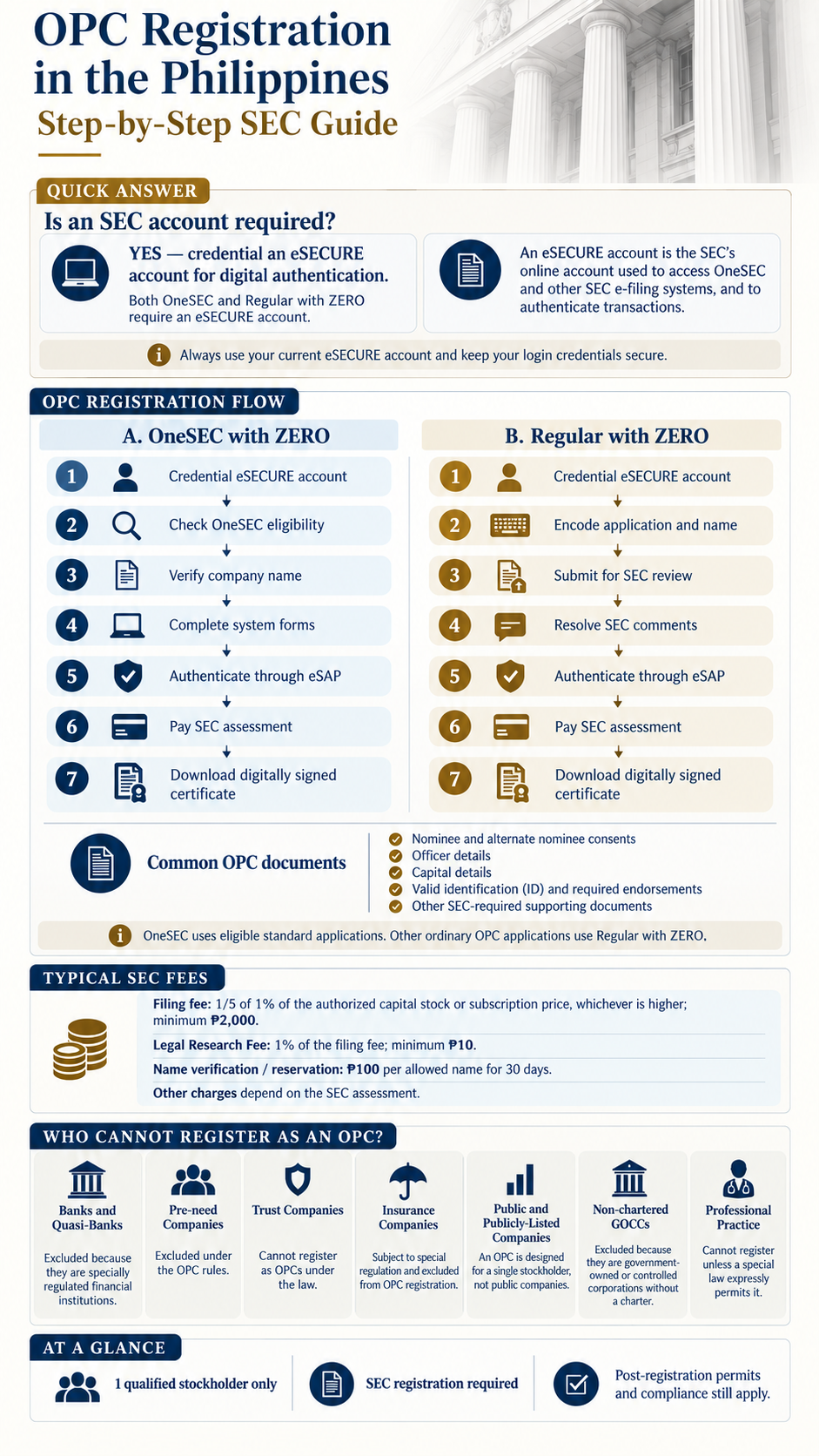
Yes. Prepare a credentialed eSECURE account. Officers who authenticate application documents through eSAP must also be registered and credentialed under the SEC OneSEC account instructions.
“all Corporate Officers authenticating the application documents are registered and credentialed in the eSECURE”
SEC OneSEC processing — eSECURE and eSAP requirements
Keep each person’s email address and mobile number accessible for validation. Confirm officer names and identity details before starting, and use each person’s own credentials.
2. Understand the legal framework
Republic Act No. 11232, the Revised Corporation Code, Section 116 defines the structure and the persons who may form it.
“A One Person Corporation is a corporation with a single stockholder: Provided, That only a natural person, trust, or an estate may form a One Person Corporation.”
Republic Act No. 11232, Section 116 (February 20, 2019)
Capital: Section 117 removes a general minimum authorized capital requirement but preserves special-law requirements. Choose capital suited to the actual business; regulated or foreign-owned activities require a separate assessment.
“A One Person Corporation shall not be required to have a minimum authorized capital stock except as otherwise provided by special law.”
Republic Act No. 11232, Section 117
Bylaws: Section 119 dispenses with filing corporate bylaws. Recordkeeping and compliance obligations remain.
“The One Person Corporation is not required to submit and file corporate bylaws.”
Republic Act No. 11232, Section 119
Corporate name: Section 120 requires the OPC designation.
“A One Person Corporation shall indicate the letters "OPC" either below or at the end of its corporate name.”
Republic Act No. 11232, Section 120
Highlighted quotations reproduce the authorities’ wording. The surrounding practical explanations are editorial guidance, separate from the quoted law.
3. Prepare the people and documents
Gather the following before encoding. The nominees support continuity if the stockholder dies or becomes incapacitated; naming them does not itself make them additional stockholders.
- Company details: proposed name, purposes, Philippine principal office address, industry classification and capital / subscription information.
- Stockholder details: identity, nationality, residence and required identification. A trust or estate must establish its representative’s authority.
- Nominee and alternate nominee: identities, contact details, authority limits and written consents.
- Officers: treasurer and corporate secretary details, and the required credentials for digital authentication.
- Declarations and clearances: beneficial ownership information and any endorsements the actual activity requires.
The articles must include the nominee information in Section 118(b). Section 124 requires the written consents with the application.
“Name, nationality, residence of the nominee and alternate nominee, and the extent, coverage and limitation of the authority.”
Republic Act No. 11232, Section 118(b)
“The written consent of the nominee and alternate nominee shall be attached to the application for incorporation.”
Republic Act No. 11232, Section 124
Section 121 makes the single stockholder the sole director and president. Section 122 prohibits appointing that stockholder as corporate secretary. If the stockholder is also treasurer, check the bond and undertaking requirements in that section.
“The single stockholder shall be the sole director and president of the One Person Corporation.”
Republic Act No. 11232, Section 121
“The single stockholder may not be appointed as the corporate secretary.”
Republic Act No. 11232, Section 122
4. Choose the correct SEC filing route
“Online versus office filing” does not describe the ordinary OPC choice accurately. The SEC’s current Regular processing notice places domestic stock corporations, apart from its lending / financing exception, under ZERO processing.
“Starting April 07, 2025, all domestic stock corporations, with the exception of lending and financing companies, will be processed through the SEC ZERO system.”
SEC Regular processing — ZERO coverage notice
| Route | When to consider it | How it works |
|---|---|---|
| OneSEC with ZERO | The application fits the portal’s standard eligibility conditions, purposes and prescribed information. | Standard forms and automated processing, with digital authentication and certificate issuance. |
| Regular with ZERO | The application needs SEC review, a purpose outside OneSEC’s scope, or required clearances / endorsements. | SEC review and corrections where required, followed by the applicable authentication, payment and approval stages. |
The OneSEC Terms of Use directs an application outside its permitted scope to Regular with ZERO.
“the registrant has to cancel the application and proceed to eSPARC Regular with ZERO processing.”
SEC OneSEC ZERO Terms of Use — alternative processing
Example: if the proposed activity needs an agency endorsement or a purpose that cannot be selected without modification, assess Regular with ZERO. Do not enter an inaccurate purpose merely to fit OneSEC.
5. Follow the registration steps
Use this sequence to prepare and track the filing. Follow the portal prompts for the route selected; Regular with ZERO can include review and correction stages.
- Check eligibility. Confirm that the stockholder, business activity, nationality and officers may use the OPC structure.
- Credential the required eSECURE users. Complete identity checks before authentication is needed.
- Select the filing route. Match the application to OneSEC with ZERO or Regular with ZERO.
- Verify the company name. Include the OPC designation and resolve objections.
- Encode the application. Enter the purpose, address, capital, stockholder, nominees, officers and declarations consistently.
- Review the forms. Check names, amounts and authority limits, and resolve any SEC compliance notice.
- Authenticate through eSAP. The required persons should use their own credentialed accounts.
- Pay the assessment. Follow the issued payment instructions and retain the evidence.
- Obtain the certificate. Download the digitally signed certificate after approval when available. Keep the incorporation documents and acknowledgments together.
The OneSEC Terms of Use identifies eSPAYSEC for payment. The SEC certificate notice confirms the validity of the digitally signed certificate.
“This certificate bears the same legal validity as with original certificate.”
SEC OneSEC processing — certificate validity
OneSEC’s target processing time is not a promise that every proposed business will be approved within one day.
Watch the SEC’s official registration tutorials
Prefer a video walkthrough? Start with the account tutorial, then choose the guide for your filing route. These videos are published by SEC Philippines on its official YouTube channel ↗.
- Create and credential your account: Watch “eSECURE Updated Tutorial Video | SEC Philippines” ↗. This explains the account stage; continue to the registration guide afterward.
- Register through OneSEC with ZERO: Watch “TUTORIAL: How to register your corporation using SEC ZERO (OneSEC Processing)” ↗. Check Section 4 first to decide whether this route fits your OPC.
- Explore other SEC registration guides: Browse the SEC’s official video library ↗. Search for Regular Processing, eSPARC, OPC, stock or non-stock corporations, partnerships or foreign corporations, according to the entity you intend to register.
For written instructions and practice, use the SEC’s interactive eSPARC tutorial site ↗, OneSEC with ZERO user guide (PDF) ↗ or Regular with ZERO user guide (PDF) ↗.
Tutorial links checked October 7, 2026. Use the channel’s video library to check for newer walkthroughs. Videos explain the filing process; read the hyperlinked legal authorities and current SEC issuances for the governing requirements.
6. Budget for SEC fees
These are standard references in the SEC Registration Calculator and SEC Schedule of Fees. They are not a fixed total. Check the current assessment, including any applicable fee relief or discount, before payment.
| Item | Standard reference | Official source |
|---|---|---|
| Filing fee | 0.2% (1/5 of 1%) of authorized capital or the subscription price of subscribed capital, whichever is higher; minimum ₱2,000. | SEC calculator |
| Legal Research Fee | 1% of the filing fee; minimum ₱10. | SEC calculator |
| Name verification / reservation | ₱100 per allowed name for 30 days. | SEC fee schedule |
| Stock and Transfer Book | Approximately ₱470, including registration, according to the calculator’s note. Confirm the actual arrangement. | SEC calculator note |
| Bylaws filing | An OPC is not required to submit and file corporate bylaws. | Section 119 |
“Filing fee is 1/5 of 1% of the authorized capital stock or the subscription price of the subscribed capital stock whichever is higher but not less than P 2,000.00”
SEC Registration Calculator — standard filing fee
“LRF – Legal Research Fee equivalent to 1% of filing fee but not less than P10.00”
SEC Registration Calculator — Legal Research Fee
Budget separately for activity-specific clearances, professional assistance, tax registration, local permits and continuing compliance. The infographic’s reference amounts do not calculate the final amount due.
7. Check who cannot register as an OPC
Section 116 excludes the following entities.
“Banks and quasi-banks, preneed, trust, insurance, public and publicly-listed companies, and non-chartered government-owned and controlled corporations may not incorporate as One Person Corporations:”
Republic Act No. 11232, Section 116 — excluded entities
- Banks and quasi-banks.
- Pre-need companies.
- Trust companies.
- Insurance companies.
- Public and publicly listed companies.
- Non-chartered government-owned and controlled corporations.
The separate professional-practice proviso in Section 116 states:
“a natural person who is licensed to exercise a profession may not organize as a One Person Corporation for the purpose of exercising such profession except as otherwise provided under special laws.”
Republic Act No. 11232, Section 116 — professional practice
Do not assume that a law office, accounting practice, medical practice or other regulated profession can be an OPC merely because it has one owner. Check the actual activity and its governing professional law. A licensed professional’s ownership of an unrelated lawful business is a different question.
This list does not override additional special-law restrictions. Foreign participation and regulated activities require a separate review before filing.
8. Complete the obligations after registration
Officer appointment and notice: Section 122 sets separate appointment and notification periods.
“Within fifteen (15) days from the issuance of its certificate of incorporation, the One Person Corporation shall appoint a treasurer, corporate secretary, and other officers as it may deem necessary, and notify the Commission thereof within five (5) days from appointment.”
Republic Act No. 11232, Section 122
2026 officer form: the SEC’s current OPC reportorial schedule states that the form is strictly required from March 23, 2026, and separately specifies the filing deadline. Appointment of officers and filing the form are distinct tasks.
“This form shall be strictly required starting March 23, 2026”
SEC current OPC reportorial schedule — 2026 officer form
“Within twenty (20) days from the approval of its Certificate of Incorporation or within five (5) days from any succeeding appointment of its officers”
SEC current OPC reportorial schedule — officer form deadline
Corporate records: maintain the minutes book required by Section 127 and calendar the current SEC reportorial requirements.
“A One Person Corporation shall maintain a minutes book which shall contain all actions, decisions, and resolutions taken by the One Person Corporation.”
Republic Act No. 11232, Section 127
Post-registration: the SEC Philippine Business Hub notice identifies company TIN and employer-number applications after successful eSPARC registration. Assess the local and sector permits needed for actual operations; incorporation alone does not authorize every regulated activity.
Separate finances: Section 130 places an adequate-financing burden on a sole shareholder claiming limited liability and addresses failure to prove separation of corporate and personal property.
“A sole shareholder claiming limited liability has the burden of affirmatively showing that the corporation was adequately financed.”
Republic Act No. 11232, Section 130 — adequate financing
“Where the single stockholder cannot prove that the property of the One Person Corporation is independent of the stockholder's personal property, the stockholder shall be jointly and severally liable for the debts and other liabilities of the One Person Corporation.”
Republic Act No. 11232, Section 130
The general corporate-personality principle appears in Concept Builders, Inc. v. NLRC, G.R. No. 108734, May 29, 1996.
“It is a fundamental principle of corporation law that a corporation is an entity separate and distinct from its stockholders and from other corporations to which it may be connected.”
Concept Builders, Inc. v. NLRC, G.R. No. 108734, May 29, 1996
This decision predates the OPC framework. It is cited for the general corporation-law principle, not as an OPC-registration decision. The OPC-specific liability rule is the statutory provision quoted above.
PRACTICAL DECISION GUIDE
9. Are you ready to file?
Ask these questions in order. Each answer identifies your next action.
- Q: Will there be only one stockholder?
If yes, continue. If two or more, assess an ordinary corporation or another structure. - Q: Is the activity permitted for an OPC?
If uncertain, check the professional or industry restriction before paying filing costs. - Q: Does the application fit OneSEC’s current conditions?
If yes, consider OneSEC with ZERO. If no, assess Regular with ZERO and any required clearances. - Q: Are the nominees, officers, consents and accounts ready?
Complete them before authentication. The stockholder cannot also be corporate secretary. - Q: Can you meet the duties after incorporation?
Prepare records, separate financial arrangements, a reporting calendar and applicable permits.
FREQUENTLY ASKED QUESTIONS
10. Practical answers
Can two people own an OPC?
No. Section 116 requires a single stockholder. Nominees do not become stockholders merely through designation.
Can a foreign national form an OPC?
The OPC form does not remove nationality, investment or business-activity restrictions. Have those requirements assessed before selecting the route or capital.
Does an OPC need bylaws?
No filing of corporate bylaws is required under Section 119. Recordkeeping and reporting obligations remain.
Can the stockholder also be corporate secretary?
No. Section 122 prohibits that appointment.
Is Regular processing the same as non-ZERO processing?
No. The SEC’s current Regular processing page includes Regular with ZERO. Ordinary OPC applications outside OneSEC’s scope should assess that route.
Does incorporation guarantee limited personal liability?
No unconditional shield should be assumed. Read Section 130’s financing requirement and its separate-property rule, and maintain the business accordingly.
Is there a fixed total registration fee?
No. Use the actual SEC assessment; the standard filing-fee formula is a reference.
11. Legal authorities and official sources
Each link opens the cited passage with text highlighting in supported browsers. Statutory and Supreme Court references use the Supreme Court E-Library; registration instructions use official SEC sources.
- Republic Act No. 11232, Section 116 (February 20, 2019)
- Republic Act No. 11232, Section 117
- Republic Act No. 11232, Section 118(b)
- Republic Act No. 11232, Section 124
- Republic Act No. 11232, Section 119
- Republic Act No. 11232, Section 120
- Republic Act No. 11232, Section 121
- Republic Act No. 11232, Section 122
- Republic Act No. 11232, Section 122
- Republic Act No. 11232, Section 116 — excluded entities
- Republic Act No. 11232, Section 116 — professional practice
- Republic Act No. 11232, Section 130
- Republic Act No. 11232, Section 130 — adequate financing
- Republic Act No. 11232, Section 127
- SEC OneSEC processing — eSECURE and eSAP requirements
- SEC Regular processing — ZERO coverage notice
- SEC OneSEC ZERO Terms of Use — alternative processing
- SEC OneSEC ZERO Terms of Use — payment
- SEC OneSEC processing — certificate validity
- SEC Registration Calculator — standard filing fee
- SEC Registration Calculator — Legal Research Fee
- SEC Registration Calculator — Stock and Transfer Book
- SEC Schedule of Fees — name verification / reservation
- SEC current OPC reportorial schedule — 2026 officer form
- SEC current OPC reportorial schedule — officer form deadline
- SEC eSPARC — Philippine Business Hub integration
- Concept Builders, Inc. v. NLRC, G.R. No. 108734, May 29, 1996
Professional disclaimer: General legal information only; this article does not create an attorney-client relationship. The appropriate structure, route and compliance requirements depend on the proposed business and its circumstances. Consult a lawyer for your particular application.